Electrical Safety Risk Assessment: How to Identify and Rank Electrical Hazards in a Facility
Electricity powers almost every aspect of a modern facility, from lighting and HVAC systems to critical equipment, production lines and emergency services. However, when electrical systems are not properly designed, maintained or operated, they can expose people and property to serious risks.
Electric shocks, electrical fires, arc-flash incidents, equipment failures and unexpected shutdowns are some of the consequences of inadequate electrical safety management.
This is where an Electrical Safety Risk Assessment (ESRA) becomes important.
Rather than simply identifying electrical defects during an inspection, an electrical safety risk assessment helps facility managers understand which hazards pose the greatest threat, how urgently they need to be addressed and what corrective measures should be implemented first.
For hospitals, industries, hotels, commercial buildings and other critical facilities, this approach helps turn electrical safety observations into a practical plan for reducing risk and improving system reliability.
1. Begin with a complete assessment of the electrical system
Before assessing electrical hazards, it is important to understand the facility's electrical infrastructure.
An incomplete assessment can overlook critical equipment or leave potential risks unidentified. The first step is therefore to prepare a comprehensive inventory of the electrical installation.
Depending on the facility, this may include:
- HT and LT panels, transformers and incoming power supply systems
- Power Control Centres (PCCs) and Motor Control Centres (MCCs)
- Distribution boards, cables, bus ducts and capacitor banks
- Diesel generator (DG) sets and UPS systems
- Motors, pumps, HVAC systems and other major electrical loads
- Solar PV installations, battery systems and energy storage equipment
- Earthing systems, lightning protection and surge protection devices
- Emergency power supplies and other critical electrical systems
The assessment should also include a review of single-line diagrams (SLDs), protection settings, previous electrical incidents, maintenance records and available test reports.
These documents help establish whether the installation is adequately protected and whether the actual electrical system matches its approved drawings and intended operating conditions.
Why does this matter? A facility may have modern electrical equipment but still contain serious safety gaps because of incorrect protection settings, inadequate earthing, undocumented modifications or poor maintenance practices.
2. Identify electrical hazards through inspection and testing
Once the electrical system has been mapped, the next step is to identify existing and potential hazards.
A reliable electrical safety risk assessment combines document review, physical inspection, appropriate electrical testing and discussions with the people who operate and maintain the equipment.
Some electrical hazards are immediately visible. Others remain hidden until suitable tests or diagnostic methods are used.
Common electrical hazards include:
- Exposed live parts and missing panel covers
- Damaged cable insulation and improper cable termination
- Inadequate earthing or defective protective bonding
- Missing, bypassed or malfunctioning RCCBs/RCDs
- Incorrectly selected or configured protective devices
- Overloaded cables, circuits and electrical equipment
- Loose connections and overheating at terminals or busbars
- Poor panel ventilation and inadequate electrical clearances
- Improper isolation arrangements and unsafe maintenance practices
- Inadequate short-circuit protection and arc-flash exposure
- Harmonic distortion and other power-quality problems
- Defective surge protection and inadequate lightning protection
- Poor housekeeping and combustible materials near electrical equipment
Not every hazard can be identified through a visual inspection alone. For example, a connection may appear normal but develop excessive heat under load. Similarly, an earthing system may be physically present without providing the expected level of protection.
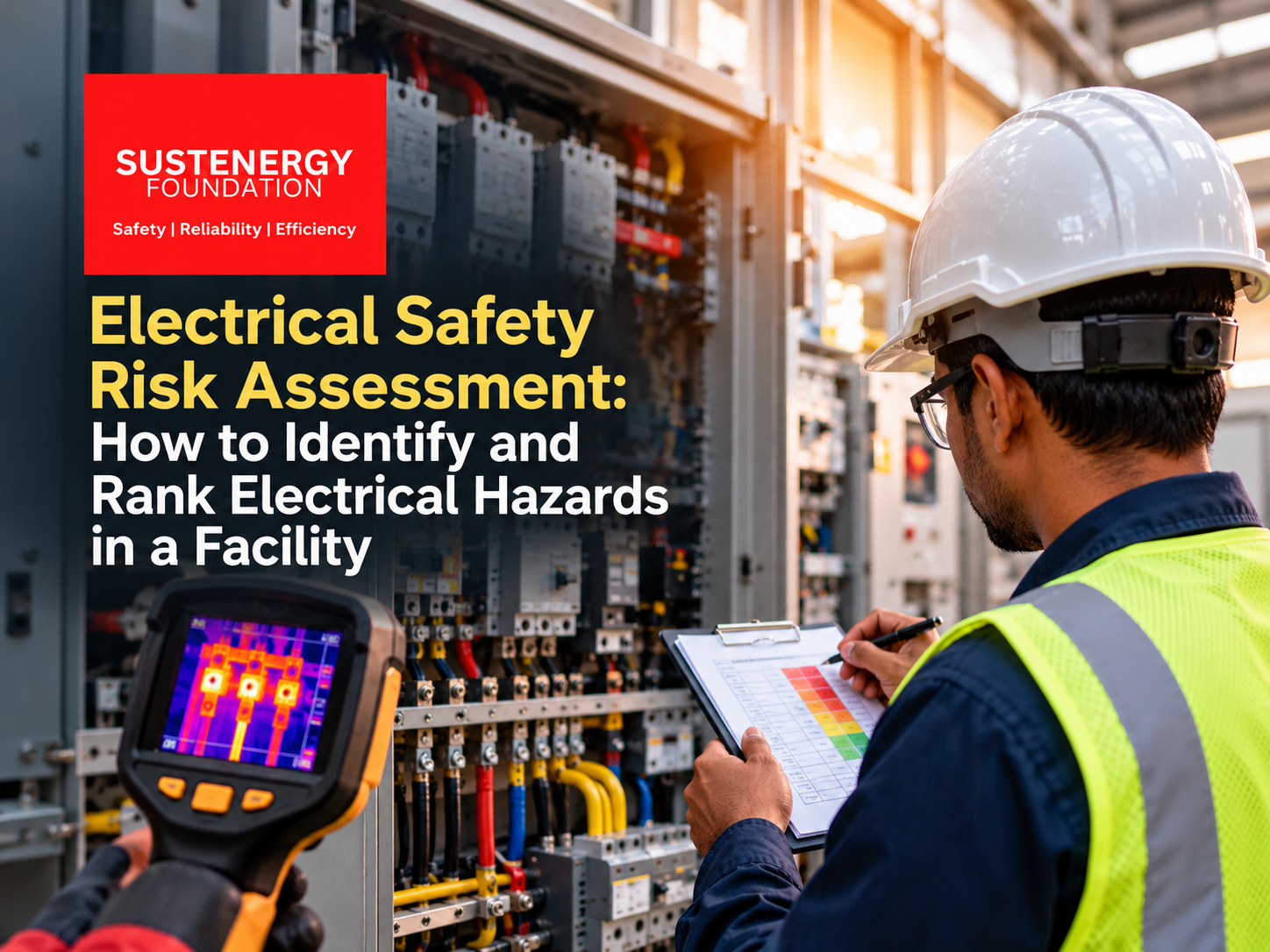
Depending on the installation, an electrical safety audit may therefore include earth resistance measurement, earth fault loop impedance testing, insulation resistance measurement, RCCB/RCD testing and thermal imaging inspection.
The assessment should also consider abnormal operating conditions, equipment breakdowns, switching activities and maintenance work—not just normal day-to-day operation.
3. Assess the likelihood and consequences of each hazard
Identifying a hazard is only the beginning. The next question is: How serious is the risk, and how quickly must it be addressed?
A practical method is to assess each hazard using two factors:
Risk Score = Likelihood × Consequence
Likelihood refers to the probability of an incident occurring, taking into account factors such as equipment condition, exposure, existing safeguards and operating practices.
Consequence refers to the potential severity of the outcome. This may include electric shock, serious injury, fire, equipment damage, business interruption or disruption to critical services.
For example, consider two observations in an industrial facility:
Example 1: Exposed live electrical parts
An accessible electrical panel contains exposed live components. Personnel may come into contact with them during routine work, creating the potential for serious injury or fatal electric shock. This condition requires urgent attention and appropriate immediate controls.
Example 2: Incomplete equipment identification
An electrical panel in a restricted-access room has an incomplete equipment identification label. Although this may not present the same immediate danger, it could create confusion during maintenance or emergency isolation. The deficiency should be corrected and its operational implications assessed.
These examples demonstrate why every observation should not automatically receive the same priority.
Risk assessment should consider both the seriousness of the possible outcome and the likelihood of exposure or failure. A hazard with severe potential consequences may require stringent controls even when the likelihood of an incident appears relatively low.
4. Use an electrical safety risk matrix to rank hazards
A risk matrix helps convert assessment findings into a consistent and understandable priority list.
One practical approach is to assign a score from 1 to 5 for likelihood and consequence, then multiply the two scores.
| Risk score | Risk rating | Suggested response |
| 1–4 | Low | Maintain existing controls and monitor |
| 5–9 | Moderate | Plan corrective action and track completion |
| 10–16 | High | Prioritise corrective action and apply interim controls |
| 17–25 | Critical | Take immediate protective action and control exposure |
Note: This is an illustrative risk matrix. Facilities should define their own scoring criteria, acceptance thresholds and escalation procedures based on applicable requirements and their operational risk profile.
For example, a hazard rated 4 for likelihood and 5 for consequence would receive a score of 20, placing it in the critical category under this illustrative matrix.
The risk rating should guide the response, but it must not override mandatory safety requirements. An exposed live part or another immediately dangerous condition must be made safe promptly, regardless of the calculated score.
The criteria may also need to be more stringent in hospitals, data centres, manufacturing plants and other facilities where an electrical failure could affect patient care, essential services, worker safety or business continuity.
5. Prioritise corrective actions using the hierarchy of controls
A risk assessment creates value only when its findings lead to effective corrective action.
The preferred approach is to eliminate the hazard wherever practicable, rather than relying solely on warnings or personal protective equipment (PPE).
The hierarchy of controls provides a useful framework:
- Elimination: Remove the hazard entirely where feasible.
- Substitution: Replace hazardous equipment or components with safer alternatives where appropriate.
- Engineering controls: Introduce physical safeguards, suitable protective devices, interlocks or other engineered solutions.
- Administrative controls: Improve procedures, training, access restrictions, inspection schedules and Lockout/Tagout (LOTO) practices.
- Personal protective equipment: Provide suitable PPE for residual risks and the specific task.
Consider an electrical panel with a potential arc-flash hazard. Simply instructing maintenance personnel to wear PPE may not be sufficient.
The facility should first evaluate the equipment, available fault current, protective-device settings, clearing times and operating conditions. Depending on the findings, suitable measures may include correcting protection settings, installing appropriate current-limiting devices, introducing remote operation or modifying equipment to reduce exposure.
The selected measures should be technically justified, implemented by competent personnel and verified before the equipment is returned to normal service.
6. Prepare a risk-based electrical safety improvement plan
After hazards have been assessed and ranked, the findings should be converted into a clear action plan.
An effective electrical safety audit report should do more than list defects. It should help management understand the risks, assign responsibility and monitor corrective action until completion.
For every significant observation, record:
- Equipment or location: Where the hazard was identified.
- Hazard description: What was found during the inspection or test.
- Risk rating: The assessed likelihood, consequence and overall priority.
- Recommended corrective action: What needs to be done to control the risk.
- Responsible person: Who will implement the action.
- Target completion date: When the action must be completed.
- Verification status: Whether the correction has been completed and its effectiveness confirmed.
For example, if testing identifies an ineffective protective device, the action plan should specify the required investigation, appropriate corrective measures, the responsible team and the verification tests needed before the circuit is considered safe.
Immediate hazards should receive prompt attention. Other improvements can be scheduled according to risk, technical requirements and available resources, provided that interim controls are adequate and no mandatory safety action is delayed.
This process helps facility managers move from identifying problems to systematically reducing electrical risk.
7. Review the assessment whenever conditions change
Electrical safety risk assessment should not be treated as a one-time exercise.
Electrical installations change over time. New equipment is added, loads increase, protection settings are modified and maintenance practices evolve. Each change can introduce risks that were not present during the original assessment.
The assessment should therefore be reviewed following significant electrical modifications, new equipment installations, changes in load, electrical incidents, protection-setting changes or revisions to operating and maintenance procedures.
Periodic electrical safety audits and preventive maintenance also help identify deteriorating conditions before they lead to an incident.
In critical facilities, this process is especially important because an electrical failure can affect not only equipment but also the services that people depend on.
8. How an electrical safety audit supports risk assessment
An electrical safety risk assessment provides the framework for understanding and prioritising hazards. An electrical safety audit helps establish the actual condition of the installation through inspection, testing and technical evaluation.
When used together, they provide a more practical basis for electrical safety management.
A comprehensive assessment may involve:
- Reviewing electrical drawings, protection arrangements and maintenance records
- Inspecting panels, cables, distribution boards and electrical equipment
- Testing earthing effectiveness and relevant protective devices
- Assessing insulation condition and identifying potential electrical faults
- Using thermal imaging to identify abnormal heating under suitable operating conditions
- Evaluating deficiencies against applicable electrical safety standards and regulations
- Preparing prioritised recommendations for corrective action
The scope and testing requirements should be tailored to the facility, its electrical infrastructure and the risks associated with its operations.
Sustenergy Foundation provides electrical safety audit services for a range of facilities, including hospitals, hotels, industries, commercial buildings and other specialised installations. Its services include electrical testing, thermal imaging and technical recommendations aimed at improving electrical safety and system reliability.
To learn more, visit the Electrical Safety Audit services page.
Conclusion: Focus on the risks that matter most
Electrical safety is not simply about finding defects or completing an inspection checklist. It is about understanding which hazards can cause the greatest harm and ensuring that the right corrective actions are taken at the right time.
A structured electrical safety risk assessment helps facilities identify hazards, evaluate their likelihood and consequences, rank risks and develop a practical improvement plan.
For facility managers, maintenance engineers and safety professionals, the objective should be clear: identify dangerous conditions early, implement effective controls, verify the results and continuously improve the safety of the electrical installation.
The most important question is not how many electrical observations were recorded, but which hazards pose the greatest risk and what action is being taken to control them.
By combining risk-based decision-making with regular electrical safety audits and preventive maintenance, organisations can better protect people, safeguard assets and maintain reliable operations.
Need professional support with electrical safety risk assessment?
Sustenergy Foundation helps organisations assess electrical installations, identify potential hazards and develop practical recommendations to improve safety and reliability.